Recruitment AI: Start With the Business Problem, Not the Technology
AI adoption in recruitment is beginning to mature.
Much of the early conversation focused on experimentation. Recruitment leaders explored large language models, consultants tested tools such as ChatGPT and Claude, and businesses tried to understand where AI might fit.
Now, the conversation is shifting towards practical deployment.
The recruitment businesses making the most meaningful progress are not simply asking:
“How can we use more AI?”
They are asking:
“Where is work getting in the way of growth?”
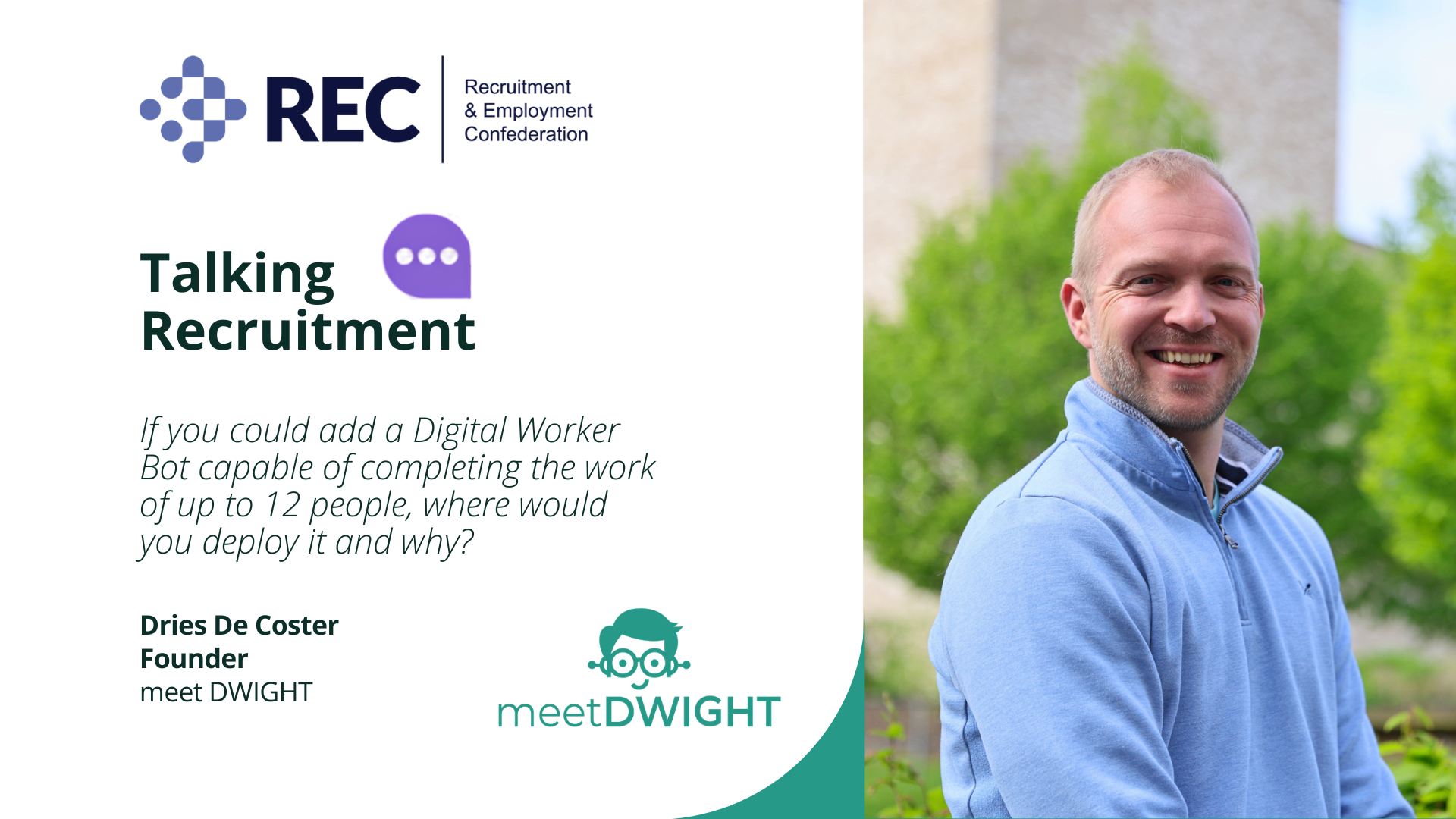
During a recent episode of the REC’s Talking Recruitment podcast, meet DWIGHT founder Dries De Coster joined REC Chief Executive Neil Carberry and CURO Services’ Annie Andrews to discuss what smart AI and automation adoption looks like for recruitment businesses.
One message came through clearly: technology should be introduced to solve a defined business problem, not because a company feels it needs an AI strategy.
AI is more than ChatGPT
For many people, large language models are the most visible form of AI.
On the one hand, they can help recruiters draft messages, summarise documents and create content more quickly. On the other, they introduce a different problem. In essence, garbage in still means garbage out. But LLMs themselves only offer one part of the AI solution.
Recruitment businesses can also use automation and agentic technologies to complete work across their existing systems. This is particularly relevant in the middle and back office, where repetitive processes often consume significant time without directly creating revenue.
These tasks may not attract as much attention as AI sourcing or candidate matching, but they have a direct impact on cost, capacity, cash flow and candidate experience.
Start by finding the time sucks
There is a temptation to begin an AI project by reviewing the technology available.
A board member asks for an AI strategy. A competitor introduces a new tool. A recruiter finds a platform that produces impressive results. The business then starts searching for a problem the technology can solve.
The process should work the other way around.
Recruitment leaders should begin by looking closely at how work moves through the business.
Where are people repeating the same task?
Where do processes slow down?
This is where the real automation opportunities tend to sit.
A useful question is:
If you could add a Digital Worker Bot capable of completing the work of up to 12 people, where would you deploy it and why?
The answer should identify more than the department with the largest workload. It should show where removing repetitive work would make the greatest commercial difference.
Could candidates complete onboarding sooner? Could invoices be raised earlier?
Those are the outcomes that should guide technology decisions.
Measure productivity, not activity
AI and automation can complete large volumes of work very quickly. However, increased activity does not always mean increased productivity.
An AI sourcing tool may find more CVs, but does that result in more placements?
A system may complete thousands of actions, but does that protect margin, improve service or accelerate revenue?
The purpose of technology is not to demonstrate how many actions have been automated. It is to improve a measurable business outcome.
Recruitment businesses have traditionally grown by adding more people. More recruiters can generate more revenue, but additional headcount also increases costs.
Automation provides an alternative. It can give existing teams more capacity, helping the business grow without increasing middle and back-office costs at the same rate.
Connect the process across existing systems
Recruitment businesses often rely on several platforms to complete one process.
Candidate information may need to move between an ATS, compliance platform, VMS, payroll system and invoicing software before the work is complete.
The problem is not necessarily that the business has chosen the wrong systems. It is that employees must often bridge the gaps between them manually.
Automation can support the complete process by transferring information to the correct system at the correct stage. This allows the workflow to continue without someone repeatedly copying data, downloading files, logging into portals or updating records by hand.
The goal is to help the existing technology stack work together more effectively.
This is especially valuable where systems have limited API functionality or where legacy technology still forms an important part of the business.
By automating the actions between systems, recruitment companies can improve the process without undertaking a disruptive replacement project.
Improve the process before automating it
Automation should not simply make an ineffective process run faster.
Before introducing technology, businesses need to understand how the work is actually completed. The documented process may be very different from the one employees follow each day.
Recruiters and operational teams may have developed workarounds because the official workflow is too slow, contains duplicated steps or no longer reflects the needs of the business.
Leaders should therefore ask important questions, such as whether every step is necessary or where tasks are duplicated.
However, this review should not lead to paralysis.
Businesses do not need to perfect every process before taking action. A sensible approach is to choose one controlled workflow with clear rules, measurable costs and a defined outcome.
The first automation project does not need to transform the entire company. It needs to solve one genuine problem and produce evidence the business can learn from.
Technology should make recruiters more valuable
Recruitment remains a people business.
Candidates are making significant career decisions. Clients expect recruiters to understand their organisations, roles and markets. Those conversations require judgement, communication, empathy and trust.
Automation should create more time for that work.
When technology manages repetitive administration, data movement, reminders, submissions and documentation, recruiters can focus on building candidate relationships and delivering a more consultative service.
Smart adoption begins with one question
The recruitment businesses who automate properly won’t be those using the most AI tools.
They will be those that apply technology deliberately to improve capacity, protect margin, accelerate revenue and strengthen their service.
Before searching for another platform, start with one question:
Where is work getting in the way of growth?
That is where your AI and automation strategy should begin.
This article is based on a conversation between Dries De Coster, Neil Carberry and Annie Andrews on the REC’s Talking Recruitment podcast. Listen to the full episode to explore their wider discussion on AI adoption, governance and the future of recruitment.
Find your biggest automation opportunity
DWIGHT works across your existing recruitment technology stack to complete repetitive middle and back-office processes.
From onboarding and compliance to VMS submissions, payroll and invoicing, DWIGHT helps the systems already within your business work together more effectively.
Book a demo and show us the process slowing your business down.